Bichon Frise
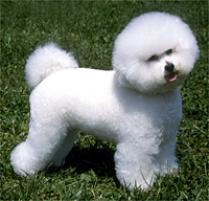
Family:
Bichon, companion, water dog
Area of origin:
France
Original function:
companion, performer
Average size of male:
Ht: 9.5-11.5, Wt: 7-12
Average size of female:
Ht: 9.5-11.5, Wt: 7-12
Other names:
Tenerife dog, Bichon Tenerife, Bichon a Poil Frise
The Bichon Frise has his roots in the Mediterranean, originally produced by crossing the Barbet (a large water dog) with small, white lap dogs. This cross eventually produced a family of dogs known as Barbichons, which was later shortened to Bichons. The Bichons were divided into four types: the Bichon Maltaise, Bolognese, Havanese and Teneriffe. The Teneriffe, which was to later become the Bichon Brise, developed on the Canary Island of Teneriffe, probably having been taken there by Spanish seafarers in ancient times. In the 14th century, Italian sailors brought specimens back from the island to the Continent, where they quickly became favored pets of the upper class. Following a series of French invasions of Italy in the 1500s, the little dogs were adopted by the French. They were special pets of Francis I and his successor, Henry III. They also enjoyed popularity in Spain, but for some reason, the breed's popularity waned throughout Europe.
He did experience a brief resurgence during the reign of Napoleon III in the early 19th century, but once again quickly faded from favor. This began a new chapter in the Bichon's history, as he sank from court favorite to common street dog. The Bichon survived, however, because of his propensity for performing tricks, he teamed with peddlers and organ grinders to entertain passerbys or fair-goers for money. With the advent of World War I, the little dogs were nearly lost. A few dogs were brought back home by soldiers, but no real effort to save the breed was made until a few French breeders began an earnest effort to establish the breed. In 1933, the name officially became Bichon a Poil Frise (Bichon of the curly coat). The breed was threatened once again, this time by World War II, and it was not until he came to America in the 1950s that his future became more secure. Even then, the Bichon Frise did not catch on until he received a new hair cut and greater publicity in the 1960s. The breed suddenly caught the attention of fanciers and was recognized by the AKC in 1971.

No comments:
Post a Comment